Curriculum and Instruction
Curriculum and Instruction
Ellington schools are committed to providing a first-rate education to all students across all grade levels. The district grows exceptional learners and leaders who are courageous, reflective, and contributing citizens of the world. We do this through a culture of learning that challenges and inspires all students. The current focus of our continuous improvement efforts is to increase student engagement and rigor across all classrooms.
Major curricular resources include Illustrative Math in grades K through ten and Core Knowledge Language Arts in grades K through five. We are also rolling out OpenSciEd curricula units for inquiry-based science K through 8. Other subjects and grade levels use district-developed and district-curated resources stored in folders so they can be accessed by and tweaked by classroom teachers with guidance from our three Lead Content Specialist teachers and under the supervision of principals and the assistant superintendent. We use iReady and mCLASS as formative assessments and screeners in math and literacy through grade eight.
In addition to fostering open lines of communication, we provide various resources to support our district families. These include multi-tiered systems of support (MTSS), behavioral supports, and our Literacy and Mathematics curriculum that offers detailed insights into our educational programs and the resources available to students. Our annual reports summarize our achievements and highlight areas for improvement, promoting transparency and accountability within our district.
For further questions or additional information, please don’t hesitate to reach out to the department at 860-896-2300. We are eager to collaborate in creating the best educational experience possible for our students.
Regards,
Oliver Barton, Acting Superintendent of Schools
Vision of the Learner
The Ellington Public Schools cultivate an engaging and dynamic culture of learning that prepares students to achieve their own individual excellence. Within a safe learning environment, our faculty and staff will foster students’ academic, social, and personal growth. Our students will participate actively and purposefully in learning, collaborate effectively within their community, think critically and creatively when facing new challenges, and communicate in ways that foster mutual understanding. The Ellington learner will actively engage in learning, build positive relationships within the community, think critically and creatively, and communicate with clarity and purpose as they navigate an ever-changing global society. Ellington Learners are:
-
- Participates actively and purposefully in learning
- Demonstrates perseverance and flexibility
- Improves understanding through reflection
- Makes meaningful connections to new learning
-
- Collaborates effectively
- Recognizes similarities and values differences
- Assumes good intentions
- Builds positive relationships
-
- Comprehends, analyzes and evaluates information from diverse sources, including AI
- Solves complex problems
- Thinks creatively
- Takes intellectual risks
-
- Advances learning through discourse
- Communicates ideas in compelling, impactful ways
- Listens for understanding
- Asks thoughtful questions

District Improvement
-
-
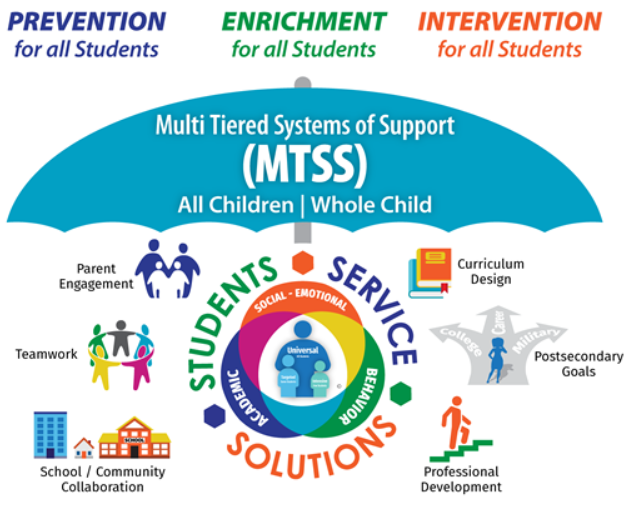
Multitiered System of Supports (MTSS)
EPS uses a Multi-Tiered Student Supports model to support student academics, behavior, and social-emotional needs. This framework recognizes that all three areas play an important role in the success of students and is intended to create close examination and discussion around student data to determine the root cause behind a student’s needs, allowing for intentional and effective supports to be put in place in order to generate student growth.
The MTSS framework consists of 4 important components: screening, progress monitoring, a multi-level (tiered) prevention system, and data-based decision making. Screening takes place multiple times per year to identify possible students who may be at risk for less than expected learning outcomes. When students demonstrate a need on a screening, further data is collected to confirm a possible need.
The Muti leveled (tiered) prevention portion of MTSS is divided among three tiers. Tier one consists of high-quality academic, social, emotional, and behavioral supports that ALL students receive. Students receiving Tier two supports receive small group or individualized interventions targeting an area of need. A student receiving Tier 3 supports will receive similar help but with greater intensity.

Progress Monitoring is a data collection process that allows schools to assess a student’s overall success, their rate of progress over a particular period of time, and to evaluate the effectiveness of current instruction. For students receiving Tier 2 or 3 services, the rate at which they are monitored increases to provide consistent data points around their progress. Ellington Public Schools uses nationally normed assessments in order to measure student success and growth.
Finally, at every point of the MTSS process data data-based decision-making allows school and district teams to make well-informed decisions about student success, student progress, and the current effectiveness of Tier one supports. This allows district resources to be utilized effectively in areas where there is clear evidence for support.
Ellington Public Schools has systems district-wide to support these areas through the use of academic interventionists, BIT (Behavior Intervention teams), as well as school and district-based attendance teams. By using the MTSS framework, Ellington Public Schools is able to make data-informed decisions that target individual student needs.
-
-